Words like doki-doki (heartbeat), waku-waku (excitement), and zawa-zawa (restlessness) are used regularly in our daily lives.
While onomatopoeia brings sound and sensations to life, not many people actually know its deeper meanings or significance.
When you consider its distinctive characteristics and its role in conversations and culture, you might find yourself thinking, “Japanese is so interesting!”
In this article, we’ll dive into the fascinating world of Japanese onomatopoeia. Packed with surprising insights and fun trivia, this guide promises a fresh look at this linguistic gem.
Why not step into its unique world and discover all it has to offer?
What is Onomatopoeia?

Onomatopoeia is a Japanese linguistic expression that conveys sounds, sensations, movements, and emotions through sound.
Examples include doki-doki (the sound of a beating heart), waku-waku (excitement), zaku-zaku (a crunchy or rough texture), and fuwa-fuwa (soft or fluffy)—terms frequently heard in everyday life.
The sheer number of onomatopoeic words in Japanese is astonishing. It’s estimated that there are over 4,500 onomatopoeic words in the language—an overwhelmingly large number compared to other languages.
These words cover various categories, such as emotions, actions, states, natural phenomena, and even animal sounds. Japanese onomatopoeia typifies the language’s ability to “express through sound.”
However, these are not mere imitations of sound. Onomatopoeia has a mysterious “power” to turn invisible sensations or movements into tangible language.
Without realizing it, we often use onomatopoeia to communicate subtle changes in feelings or the atmosphere.
Perhaps Japanese conversations rely more on sounds than we think!
The Power of Onomatopoeia from a Linguistic Perspective
Onomatopoeia isn’t just about imitating sounds. From a linguistic standpoint, it’s deeply rooted in a phenomenon known as sound symbolism—the intuitive connection between sounds and the meanings they convey.
For instance:
- Explosive sounds like pa or ka often convey sharpness or lightness.
- Soft sounds like mo or nu evoke feelings of heaviness or viscosity.
- Frictional sounds like sa or shi suggest lightness, delicacy, or coolness.
- Resonant or guttural sounds like go or zu imply weightiness, dullness, or discomfort.
This direct link between sound and meaning makes onomatopoeia particularly intuitive and easy to understand, even for small children or people learning Japanese.
Here’s a quick chart summarizing how sound types are often associated with certain feelings or sensory impressions:
| Sound | Associated Feelings/Impressions | Examples |
|---|---|---|
| Pa/Ka | Light, sharp, bursting | Pari (crispy), Kari-kari (crunchy) |
| Mo/Nu | Soft, heavy, viscous | Mocchiri (chewy), Nuru-nuru (slippery) |
| Sa/Shi | Light, delicate, cool | Sara-sara (smooth), Shin-shin (quiet snow falling) |
| Go/Zu | Heavy, dull, unpleasant | Zussari (heavy), Gotsu-gotsu (rugged) |
This inherent “seed of meaning” hidden in each sound explains why Japanese onomatopoeia resonates so strongly.
Fun Facts About Onomatopoeia You Might Not Know
The Hidden Rules of Onomatopoeia
Japanese onomatopoeia follows certain patterns.
For example, repetitive phrases like doki-doki (thumping heart), waku-waku (excitement), or zaku-zaku (rough/crunchy texture) typically depict continuous states or repeated actions. These expressions convey ongoing movement or sensations, such as a heartbeat that keeps racing (doki-doki) or a growing feeling of excitement (waku-waku).
On the other hand, single, abrupt sounds like pita (suddenly stopping), chira (a quick glance), or bashi (a sudden hit) usually describe one-time actions or sharp changes. For instance, pita perfectly captures the nuance of someone coming to a complete stop, and bashi highlights the decisive sound of a hit.
The Role of Onomatopoeia in Manga and Anime
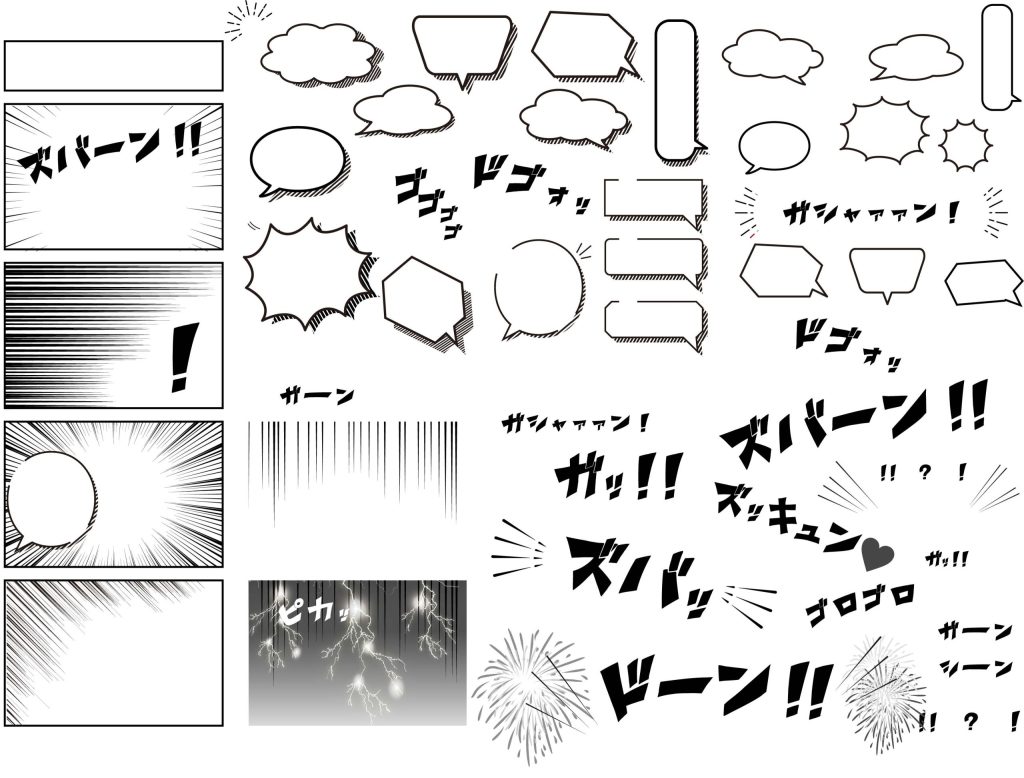
Japanese onomatopoeia plays a crucial role in manga and anime. Expressions like zouuun! (dramatic tension) or dokun… (a beating heart) vividly convey emotions, often more effectively than dialogue itself.
By embedding these sound effects into the visuals, manga and anime amplify the drama and immerse readers or viewers in the scene.
Onomatopoeia doesn’t just add words to the page or screen—it breathes life into the story’s emotions!
Why Onomatopoeia is Hard to Translate

Japanese onomatopoeia is notoriously hard to translate into other languages. The challenge lies in the fact that these words are packed with nuances that combine sound, emotion, and cultural context, making them difficult to fully convey.
For instance:
- The Japanese word mochi-mochi refers to a soft yet slightly elastic texture, often used for foods like rice cakes. While “chewy” might be the closest translation in English, it lacks the nuanced images of light, pleasant elasticity that Japanese speakers associate with the word.
- Similarly, fuwa-fuwa (soft, fluffy) and zaku-zaku (crunchy, textured) might be rendered as “fluffy” and “crunchy,” but these English words fail to capture the rhythmic, sensory appeal of the Japanese originals.
In essence, Japanese onomatopoeia doesn’t rely solely on meaning—it communicates directly through sound. This makes it a uniquely Japanese phenomenon and one reason why the language is often considered “felt through the ears.”
The Use of Onomatopoeia in Product Names
Onomatopoeia is widely used in advertising and product branding since it resonates with people’s sensory experiences, especially in food and beauty products.
For example:
- In food products, terms like fuwa-fuwa pancakes (fluffy pancakes), zaku-zaku chocolate (crunchy chocolate), or mochi-mochi udon (chewy udon noodles) immediately spark appetites by evoking texture and taste.
- In beauty products, terms like kira-kira nail polish (sparkling nails), shittori lip balm (moist lips), or tsuru-tsuru skin (smooth skin) create an enticing sensory image.
These words influence purchasing decisions by making a product feel more appealing—and businesses know it!
Trending Onomatopoeia: Social Media Star
Onomatopoeia thrives in the age of social media, where short-form text must pack a creative punch.
Expressions like mochi-mochi (chewy texture), pari-pari (crispy sound), or jyuu~ (the sizzling of meat) bring dishes to life on platforms like Instagram or TikTok. Adding hashtags such as #fuwafuwa (fluffy), #sarasara (smooth), or #saku-saku (crunchy) amplifies the sensory appeal of posts.
Don’t forget ASMR videos, where creators describe crispy or sizzling sounds through literal onomatopoeic words, stimulating auditory and visual sensations at once.
In this sense, onomatopoeia is the perfect tool for sharing experiences that transcend language barriers.
Why Kids Learn Onomatopoeia First
When children first begin to speak, onomatopoeic words like wan-wan (dog), buu-buu (car engine), or guruguru (spinning) are often among their earliest words.
This is because the direct connection between sound and meaning makes these words easier to understand. Compared to abstract words, onomatopoeia resonates more naturally with a child’s developing senses.
This is also why Japanese learners, even adults, are drawn to onomatopoeia—it’s a simple yet powerful entry point into the language.
The Power of Sound in Japanese Language

Onomatopoeia captures the essence of Japanese culture. These sound-based expressions can convey textures, movements, and even emotions, enriching conversations and making communication more personal.
By simply hearing fuwa-fuwa or doki-doki, you can imagine the mood and sensations being shared. This intuitive exchange of feelings is a hallmark of the Japanese language.
Onomatopoeia is vital not only for daily conversations but also for child development, cross-cultural communication, advertising, and even social media entertainment.
Understanding the strength of sound will surely make you appreciate Japanese even more!